



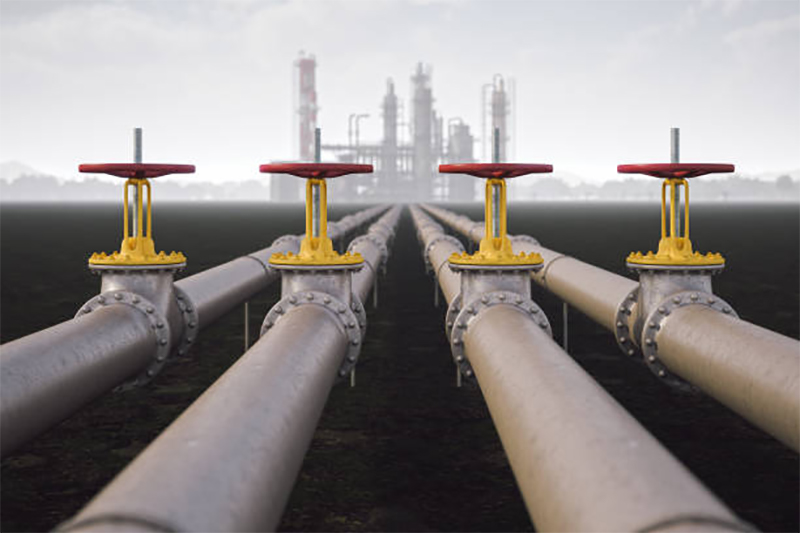
Nigeria’s gas story is a paradox of abundance without accessibility. With over 200 trillion cubic feet of proven natural gas reserves, we should be energy-rich powering homes, industries, and exports. But in reality, gas is flared, wells are capped, and industries scramble for costly energy substitutes. The true bottleneck is not a lack of molecules; it is a lack of infrastructure. For decades, Nigeria has focused on upstream expansion incentivizing exploration, awarding marginal fields, and launching headline initiatives like the Decade of Gas. But these efforts have not been matched by a coordinated midstream strategy. Without pipelines, compression systems, and processing hubs to move gas from production zones to demand centers, our reserves remain economically stranded.
A Broken System Due to Separation
Gas-bearing fields in the Niger Delta flare valuable molecules daily because there is no pipeline to evacuate them. Several non-associated gas wells have been tested and suspended not due to geologic failure, but because of a lack of evacuation routes. While, in the southwest, industries depend on LNG trucking since the pipelines terminate short. Power Plants from Geregu to Ihovbor run far below capacities, consistently citing ga supply constraint. The Ajaokuta-Kaduna-Kano (AKK) pipeline, a flagship infrastructure project meant to connect southern supply to northern demand, is still under construction after years of delays. Without timely delivery, gas-consuming states like Kano and Abuja will continue to wait for a transformation that is always just out of reach. What we see today is not the absence of aspiration, but mismatched execution. The misalignment of upstream production and midstream delivery has divided the entire gas value chain.
Regional Disparities Call for Localized Solutions
The infrastructure mismatch across Nigeria is not evenly distributed, it is regional. Gas is produced in the South-South, but demand is highest in the industrial Southwest and commercial North. Yet, without functioning evacuation routes or timely pipeline delivery, these regions remain disconnected. The consequence is a patchwork energy map where industries rely on LNG trucking and power plants remain underutilized. What Nigeria needs is not a one-size-fits-all model, but a localized midstream development strategy one that recognizes regional gas dynamics and treats infrastructure as a national economic backbone, on par with roads and electricity transmission.
Introducing the Gas Infrastructure Deficit Index (GIDI)
To close this gap, Nigeria needs more than policy statements we need data-driven planning. That is why I propose the creation of a Gas Infrastructure Deficit Index (GIDI): a national diagnostic tool to assess and rank midstream readiness across states and basins. GIDI would assess major infrastructure indicators and give a score of 0-1 for every region. The indicators would be:
- Pipeline coverage per producing basin – installed pipeline as a percentage of gas potential.
- Compression capability as compared to manufacturing – how much pressurized gas can be transported efficiently.
- Ratio of stranded to connected gas wells – an indicator of infrastructure reach and connectivity.
- Average distance of gas transmission to industries – ease of market access logistics
- Project delay and abandonment rates – how often infrastructure projects are stalled or never completed.
Areas above 0.80 would be rated as “Excellent” and areas below 0.40 would be highlighted as “Critical.” It brings in the element of accountability, transparency, and clarity of investment. With GIDI, top decision-makers can shift from broad-based interventions to focused, high-impact initiatives. If only such a tool existed five years back, the AKK pipeline corridor would have been highlighted much earlier as requiring immediate coordination, and stranded stock in Imo and other locations would have drawn modular solutions more quickly.
Overcoming the Coordination Gap
Upstream operators cannot fix this alone. We need a cross-agency Midstream Infrastructure Coordination Taskforce, bringing together the Nigerian Upstream Petroleum Regulatory Commission (NUPRC), Nigerian Midstream and Downstream Petroleum Regulatory Authority (NMDPRA), Nigerian Gas Company, and private infrastructure players. This taskforce should be charged with identifying high-impact deficit zones, de-risking private investments, and publishing an annual GIDI scorecard. There should also be incentives through gas infrastructure deployment tax credits, regulatory guarantees for third-party pipeline access, accelerated clearances for virtual pipelines and modular gas processing units. These are not just policy tweaks; they are enablers of a gas-led industrial future.
Big Ideas
Nigeria’s hopes for gas cannot be realized without closing the midstream gap. The molecules exist; the market exists but It lacks infrastructure and the concerted will to create it. The introduction of the Gas Infrastructure Deficit Index (GIDI) can be a turning point. By checking in on where we are and discovering where we come up short, GIDI can be the catalyst for smart investment, savvy planning, and better energy outcomes. Infrastructure is not the end of the gas story, but it is the missing beginning.